What is a PSYCHOPOMP?
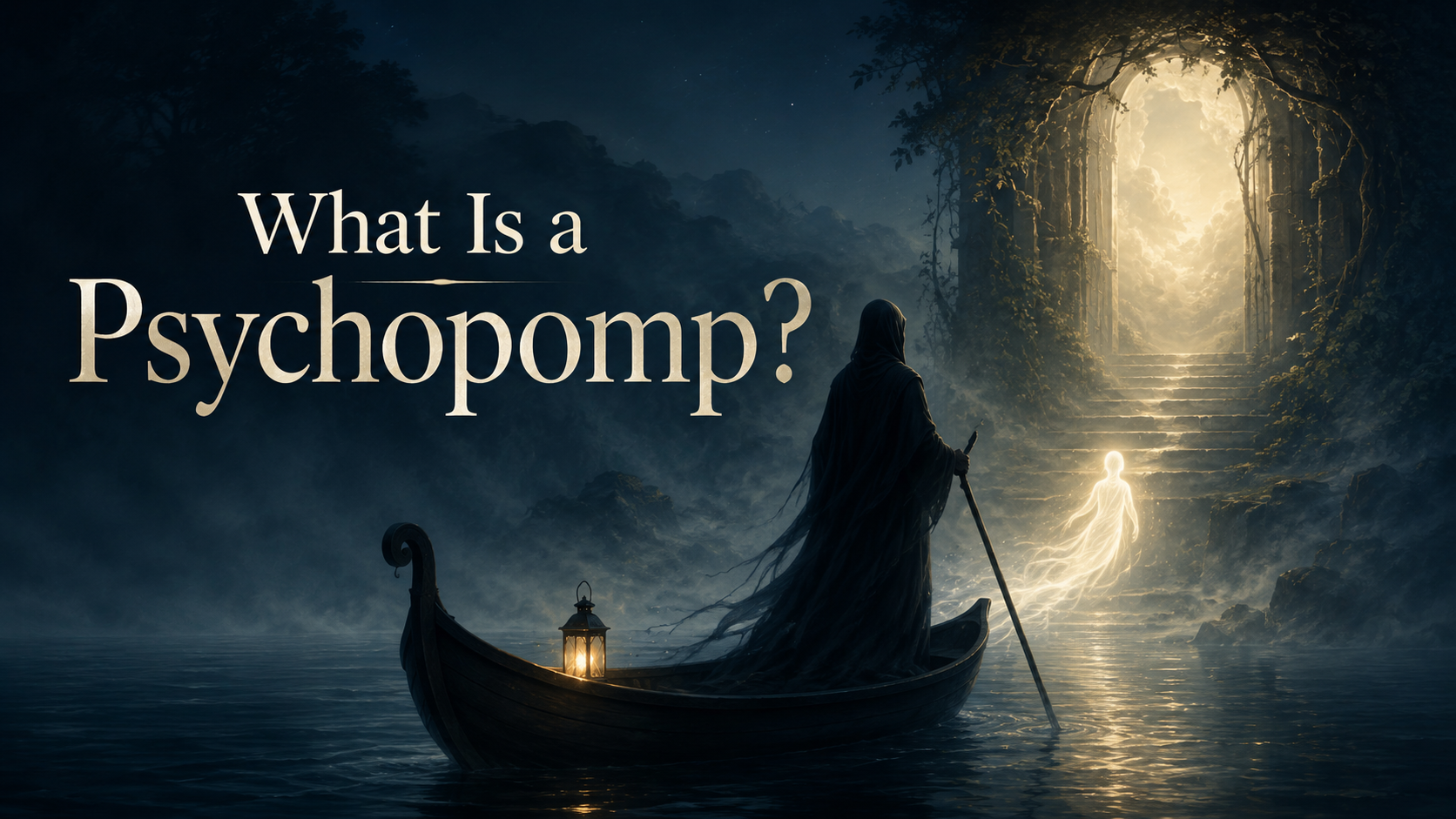
A psychopomp is a guide for the dead. The term originates from the Greek words pompos (conductor or guide) and psyche (breath, life, soul, or mind).
The closest I have ever come to being one was sitting beside my father’s hospital bed, trying to say the right thing when there was no right thing to say.
In mythology, psychopomps are the figures who escort souls from this world to whatever comes next. Charon ferries the dead across the River Styx. Hermes moves between realms. Anubis guides souls through the afterlife. The Grim Reaper is probably the most famous modern version — though the fact that he’s cold and terrifying probably tells us plenty about how the West views death.
Different cultures have imagined psychopomps differently, but the thread is always the same:
Death is not a solo journey.
That idea has always moved me.
Cultures throughout the world and throughout time have created some version of a psychopomp because, for most of human history, death was treated as part of life. Terrifying, sacred, mysterious, inevitable — but still part of the human experience.
Here in modern America, we’re not quite as graceful about it.
We worship youth. We optimize our bodies. We inject, supplement, moisturize, biohack, manifest, and generally behave as if death is something that happens to people who didn’t ‘max’ hard enough — and who didn’t quite manage to hack their way out of being human.
When I was younger, I think some part of me believed that too.
Not logically, of course. I knew death existed. I had seen enough movies and read enough Russian literature to understand the general concept. But emotionally, I think I believed the Grim Reaper might show up at my doorway — during my years of taking stupid risks like skydiving, surfing breaks I had no business being at, or taking the train home by myself in New York at five in the morning — he’d take one look at me, decide that while I was clearly brazen and stupid, I still had too much life left to live, and move on to the next passenger.
At the same time, I was also weirdly fascinated by death.
During the period of my life when I felt most immortal, death also felt, strangely, like an answer. Not because I wanted some grand dramatic exit, but because I was in pain, and some part of me hoped death would mean the pain would stop and the mysterious questions would finally be answered.
Do I still feel that way?
Not really.
Now that I actually love my life, death has become significantly less charming.
Obnoxious how that works.
But that fascination never fully left me. What changed was the question. I’m less interested now in what death solves, and more interested in how we help one another face it.
Because no one wants to die alone.
And maybe that’s the real reason psychopomps exist. Not just because humans needed an explanation for where the soul goes, but because we needed to imagine someone kind enough, brave enough, or cursed enough to walk with us to the edge.
In the modern world, a psychopomp might not wear a hood or carry a lantern.
It might be a death doula. A palliative care doctor. A hospice nurse. A chaplain. A daughter sitting beside her father’s hospital bed.
My father, Felix, died a few years ago. Sitting with him near the end was hard. Terrifying. Heartbreaking. But also kind of….holy?
He was scientifically minded and claimed not to believe in an afterlife. But as I sat beside him, I told him I would talk to him every day regardless.
I wanted him to know he would not disappear.
I wanted him to know he would be remembered.
I wanted, in whatever small and imperfect way I could manage, to help him feel less alone.
I won’t lie. I haven’t kept that promise perfectly.
Two years have passed, and there are days when I forget he’s gone. Then suddenly I remember, and the grief returns in that strange, quiet way grief does. Not always as devastation. Sometimes just as a warmth in my chest, followed immediately by the ache of missing him.
But when I do think of him, I can still feel his energy. I still talk to him sometimes. Maybe not every day. Maybe not the way I promised. But enough to know that love does not end cleanly at the hospital bed.
That, to me, is the power of the psychopomp.
Not the certainty of an afterlife. Not proof. Not doctrine. Not even comfort, exactly.
A psychopomp is the presence at the threshold.
The one who says: I’m here. You are not forgotten. You do not have to cross alone.
And maybe, in that sense, many of us have been psychopomps without realizing it. Anyone who has held a hand at the end. Anyone who has whispered reassurance into a room full of machines. Anyone who has promised to remember.
Maybe we created psychopomps because death is too enormous to face without a guide.
Or maybe we created them because, deep down, we know that love itself is a kind of escort.
A way of carrying each other as far as we’re allowed to go.